back to power
PWM
PWM:
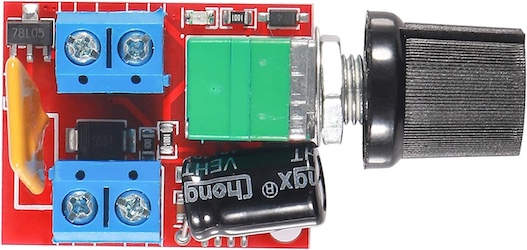
Pulse Width Modulation (PWM) is a very efficient way to provide adjustable power output. Instead of adjusting
the voltage, the output is rapidly switched between ON and OFF. The percentage of time spent on (Duty Cycle)
is then adjusted to produce the desired average continuous power output.
Typically, the speed of these transitions is fixed at somewhere around 30kHz, which is fast enough for most
resistive loads to behave as though the voltage is being adjusted instead of modulated. Since switching is
"all-or-nothing", the controlling waveform can be sent directly into the gate of a mosfet and run with very
high efficiency. Speed control of DC motors is also very common, as is LED brightness control. PWM output
isn't compatible with all types of loads, and also can produce high levels of EMI.
The PWM signal itself can also be used as an adjustment indicator for remote controllers, and is common in
applications such as speed control for fans and servo positioning controls using radio control. In those
applications, a duty cycle of 50% is "minimum", and 100% is "maximum", with values in between corresponding
linearly throughout the position range of the receiver. PWM can also be used to transmit back linear position
information such as RPM or temperature readings throughout a predetermined range. When used as an indicator,
the PWM signal provides little current, and the variable duty cycle of the signal is the only useful feature.

90w PWM controller

PWM projects

YR-1001 fan speed controller
last updated 07/16/2026 at 08:00:11 by make_www_index.command version 2026.07.10.A